-
Introduction
On this blog, I will share thoughts on spirituality, mental health, and recovery, as well as some writings.

Welcome to my new blog! I am Mike, a person in recovery. I struggled with depression & anxiety for about 18 years now. Often it was severe enough that I used alcohol to self-medicate. I realized I’ve been sober about half of that 18 years but its been a constant struggle. My spiritual journey is a literal matter of life and death to me. Without it, I will eventually destroy myself with alcohol because the pain of existing in this world is too much without a perspective that allows me to let it all go. I hope to share that with you in an authentic way here.
Meaning of two shadows
Why the title Two Shadows? I recently visited the Zen Center of Denver to expand my practice. I did my first zazen meditation, which is done eyes open. Very different for me! I was facing the wall and noted there were two shadows on the wall due to different light sources. So many different thoughts came to mind! One of the spiritual teachers I love is Baba Ram Dass, another is Father Richard Rohr. Ram Dass would speak of it as living on two planes of consciousness, as Christ said, “In the world, not of the world.” Rohr would describe it as true self and false self. The false self being the ego-identified self of “reality” as we know it. The true self being the transcendent, spiritual self. “False self” is a misnomer. It is in fact real; we just believe in it too much. There is more truth to be found in the true self, but it exists in conjunction with the false self. As Thich Nhat Hanh (Thay) would say, they “inter-are.” One does not exist without the other. If those two shadows on the wall were imbued with the kind of consciousness we have as humans, they may believe themselves to be separate from each other, possibly each considering themselves to be the true reality and superior to the other. Of course their separateness is an illusion. They are united by the one unified body that allows them both to be.
The shadows call to mind another important concept – impermanence. That idea is very central to Buddhist teaching and very important to me personally. The shadows briefly came into existence when I sat and were extinguished as soon as I stood up (or tried to given that my legs had fallen asleep from sitting cross-legged for 25 minutes). I believed my suffering was permanent. Any brief breaks from it would eventually lead me back to it, and that thought alone made life unbearable. Many are familiar with the Buddhist teaching – In this life, there is suffering. Made plenty sense to me, but I was one of many who just stopped there. Had I kept inquiring, I would have learned that the Buddha also taught there are causes, an ending to, and a path out of our suffering! These are The Four Noble Truths. Like everything else, suffering was not only impermanent but can be the very thing that leads us to joy! I got a harsh lesson in impermanence last year with the death of my father. Much of my future musings will be around that concept of impermanence.
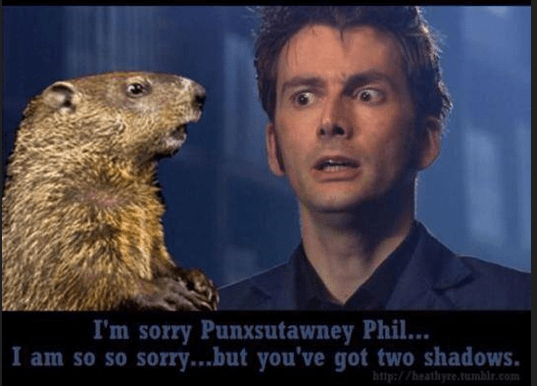
There is a finally meaning to two shadows. As any Doctor Who fan knows, seeing two shadows means you are about to die. The Vastha Nerada cause the second shadow and will soon strip all the flesh off your body! Memento mori was my final lesson from those two shadows, a reminder of my own impermanence and what a gift the present moment is!
I look forward to sharing some of my present moments with you!
Ram Dass – “Be Here Now!”
-
Original Sin and Dukkha
“Meditators since the beginning of time have known they must use their own eyes and the language of their own times to express their insight. Wisdom is a living stream, not an icon to be preserved in a museum.”
– Thich “Thay” Naht Hanh, “The Sun, My Heart” Introduction

https://www.flickr.com/photos/62698615@N08/5851636014 Growing up Catholic, I am familiar with the concept of original sin. I believe it is one of the most misunderstood (often intentionally so) concepts in theology. Many look back on their experience believing they were taught that they were born evil and should feel guilty about it. Some probably were, and some view their lessons in original sin as an important instrument in their very real experience of religious trauma. The Adam and Eve story has certainly done its own damage, many throughout the course of history pointing to it to suggest the natural weakness of women and their role as temptresses of sin. Patriarchal societies find this to be easy ammunition for the subjugation of women.

https://openverse.org/image/1cc58951-f02e-4b49-9a78-d0e2b54b18f1?q=cross%20pic I’d like to share my new a viewpoint for this concept of “original sin” that sees it as a rich insight into the nature of the human condition. It seems, using religious language, we are born outside of a proper relationship with God; and to apply more secular language, our natural instincts lead us to pursue things that will only make us suffer. (Note: I believe both of these statements are equivalent and only semantically different. You may choose the one you are most comfortable with, or as Thay would challenge you to do, use your own wisdom and experience to find the words that speak this truth to you.)
How is it so, that so many have observed we are born into a path that leads us to suffer? Think about a newborn infant. As a person trained in pediatric medicine, I know there is no more encouraging sign than a baby who rockets into this world and begins life with a passionate, vigorous cry. The lungs expand and a life-long process of oxygenating the blood to spread throughout the rest of the body begins. Something that looks like (and is truly) the most unpleasant experience (that first experience of being cold, of physical pain, and sensation of suffocation that drives the necessary process of breathing) are our first experiences of this world.
But I believe it goes far beyond that. That newborn, once calmed (and even during those intense first moments), is experiencing the most authentic perception of reality (the true essence of Zen) – the true Beginner’s mind that is the pursuit of a Zen practitioner. There is no judgement, no dualism of thought. There is the true experience of “non-self” because they have no concept of what a self is or that they might be somehow separate from what they perceive. Original sin comes later. That infant begins to understand that some sensations are pleasant and some are unpleasant. The onset of dualism is unavoidable, it is the original sin we all commit even though there is no way around it. Furthermore, the inevitable conclusion is, “I am here to experience the pleasant things, and shun the unpleasant. If I can simply rid my life of the unpleasant experiences and sensations and, I can finally be happy!”
It is this error in logic that leads to suffering in this life. The pursuit of pleasure and avoidance of all undesirable perceptions seems logical, and many live an entire lifetime never shedding this belief that that path leads us to exist happily as a human. The reason it cannot is that we cannot escape suffering. This is dukkha in Buddhism. Many believe that the Buddha said, “existence is suffering.” My understanding is a better interpretation is that existence is unsatisfying and uneasy, not necessarily painful or unhappy, although it certainly can be sometimes. Original sin and dukkha get at equivalent concepts in my mind, that our natural desires lead us to an unsatisfying experience and requires a retraining of our minds to escape that trap. But how do we do that?
The story of Siddhartha Gautama (the Buddha’s original name) is one of a rich, entitled prince whose father sought to shield him from experiencing suffering, not even allowing him to observe the process of aging, switching out his servants and those around him to present a picture of eternal youth.
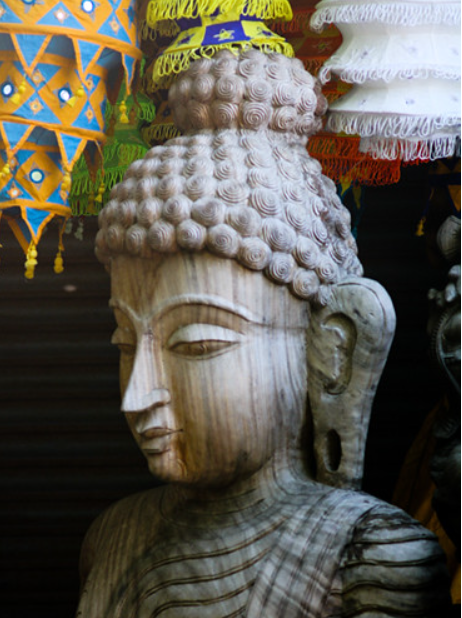
https://www.flickr.com/photos/32782884@N05/5320215682 The first time he encountered an elderly man, he was confused and did not understand what he was seeing. He left to explore many paths to understand this experience of aging, disease, and death that he learned about later than most. He tried a variety of paths – pure hedonism and pursuit of pleasure, pure asceticism and denial of desires. Eventually, passing through suffering he learned the path out and adopted and taught others what is known as “the Middle Way.” Resisting all desires increases suffering. Pleasure is not to be avoided but not to be clung to. Understanding the true nature of our suffering and desires, allows us to live in a way in tune with the reality of our nature. To live in Buddha mind, Christ consciousness, or simply live a balanced life.
Why are we like this? What’s the point of making the Tree in the first place, God? Why does every insight I have into the reality of human nature just seem to lead to more questions? Seriously why, I’m pretty stuck here. I’d like to share some pithy allegory from Buddha or Jesus or Thay or Ram Dass, but I’m coming up dry. Even the modern poet, philosopher, theologian, and self-admitted megalomaniac Bono of U2 once said, “Once we are born/ we being to forget/ the very reason we came,” but fails to explain to us why that is. I just spent a ton of money to see you perform in Las Vegas with your little band, Paul! I’m expecting some serious answers to these plaguing questions, or I ain’t buying a bobblehead or T-shirt!
-
Space Travel and the Joy of Being
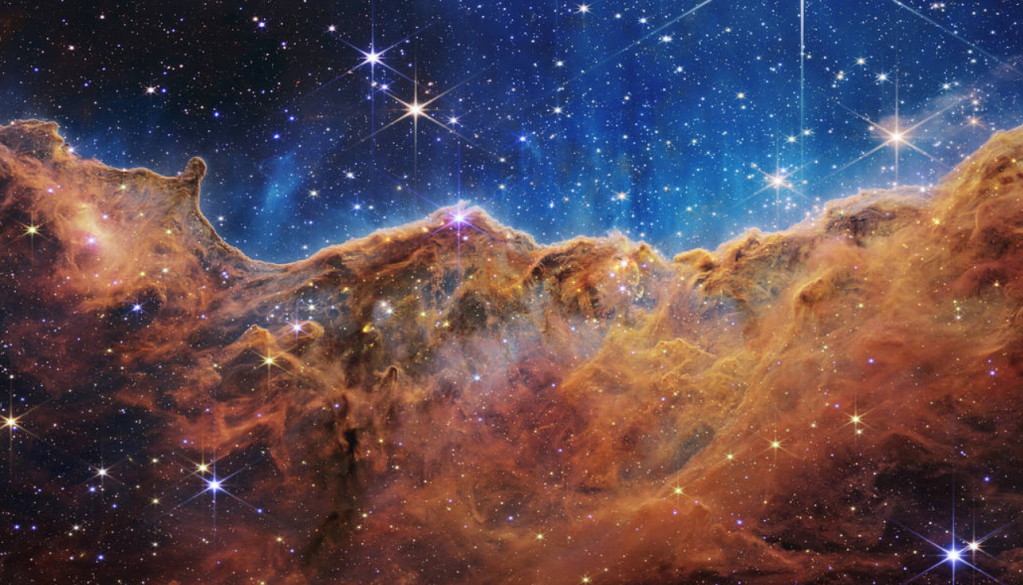
https://www.nasa.gov/image-feature/goddard/2022/nasa-s-webb-reveals-cosmic-cliffs-glittering-landscape-of-star-birth This is a guided visual meditation of which I am fond. I use this often to reset myself or when things feel overwhelming. I developed it over time after listening to a discussion on a podcast (possibly Duncan Trussell or Pete Holmes). Unfortunately, I cannot recall where I heard the initial discussion that led to this, but I can’t claim it as entirely original.
Ideally Dear Reader, you would be able to sit with your eyes closed and listen to this being recited while your imagination took you on this trip. Alas, if you are too curious to set that up with a fellow space traveler, you may read this slowly and mindfully to yourself. Stop often to allow yourself to drift into the story and resume when ready. Proceed to launch when ready!
[Note: this is as close to scientifically accurate as a I can get with doing no actual research, so step out of your thinking/discriminating mind and don’t Neil-DeGrasse-Tyson me, please!]
Start by taking 3 to 5 deep, slow, cleansing breaths. To set the scene, it is many years in the future and you are a certified explorer. You live on a giant mothership travelling into the far reaches of space. You receive orders every few days to zip off in your personal spacecraft, explore a section of space, and report your findings. Recently you learned of a solar system that you will be passing soon, devoid of all intelligent life, that your supervisors have deemed unworthy of exploration. Your curiosity has peaked as you could be the only living being to ever see this section of the universe!
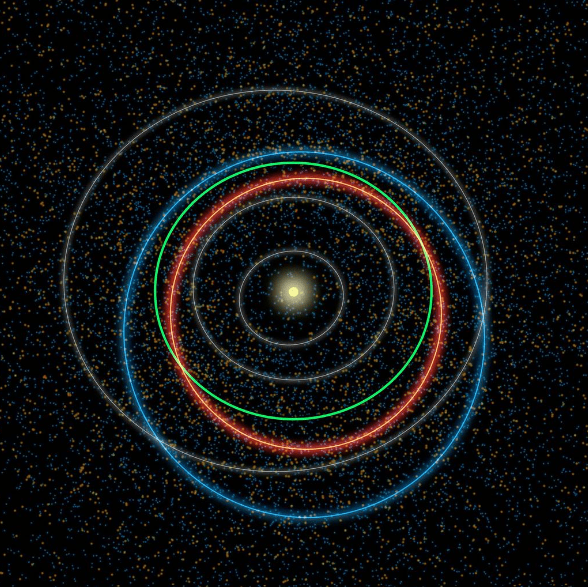
https://www.nasa.gov/mission_pages/WISE/images/index.html That night, instead of retiring to your sleeping quarters, you slip past officials on duty at the launch pad and sneak your ship out without detection (not the first time you’ve done this to be honest, you have a bit of reputation for this in fact). You fly the coordinates to this unexplored solar system, and what you find does not disappoint! You buzz past dwarf planets to see the imposing and colorful gas giant planets of this system. You briefly contend with an asteroid belt (the navigation system can do this but you prefer the thrill of manually dodging these space rocks) and come out of it to find the lush and beautiful mid-sized planets closer to the solar system’s star.
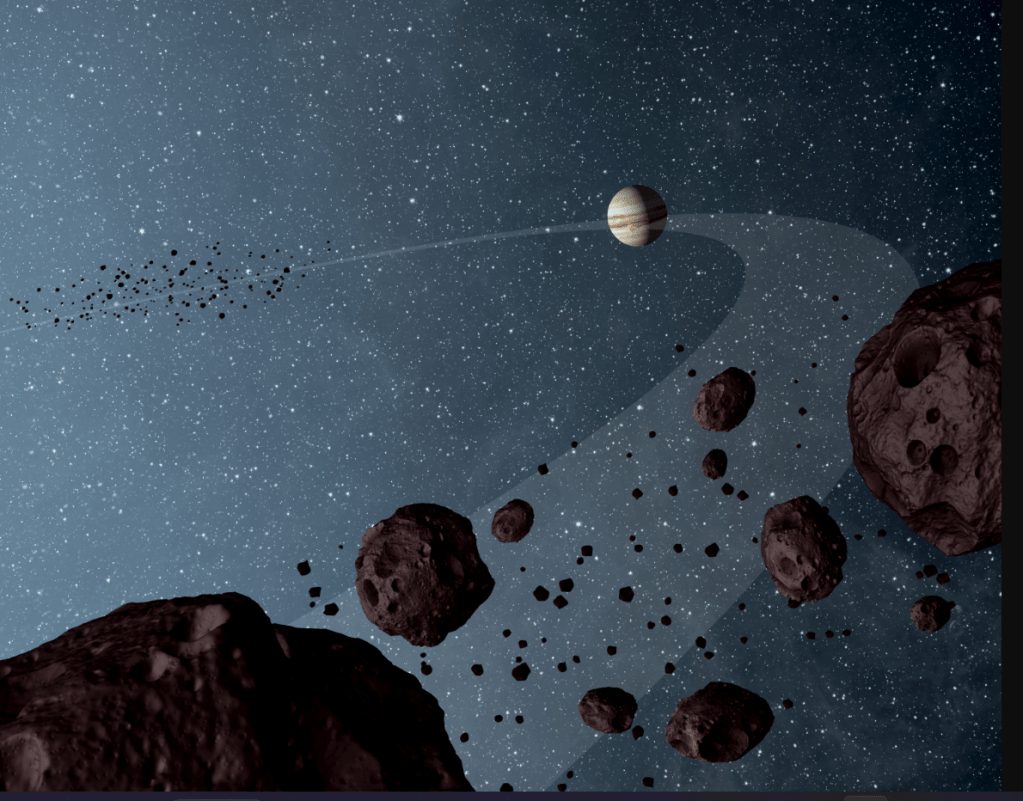
https://www.nasa.gov/sites/default/files/images/697015main_pia16211_full.jpg One planet looks particularly earth-like and you decide one last close up look before heading back to the mothership won’t put you at any greater risk of detection from the grumpy guards and stuck up supervisors. You descend for a closer look, but fail to account for the planet’s second moon’s gravity and lose control of your ship. The voice of your old mentor rings in your head, “A properly filed flight plan would have accounted for that additional gravity.” Your crisis flight skills kick in and you set yourself on a descent path that ensures you will not burn up in the planet’s atmosphere. You crash with a thud, secured by full body airbags, you sustain no injuries in the crash landing.
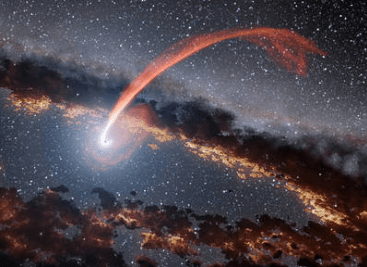
https://www.nasa.gov/mission_pages/WISE/images/index.html You begin your data gathering by incasing yourself in your spacesuit. Unlike the clunky models of our time, this is basically an invisible bubble that surrounds you supporting your life functions in hostile conditions while allowing full sensory interactions with the environment (i.e. you can taste, smell, feel, hear, and see the space around you unobstructed as if you were home on earth or the mothership). The news isn’t good. Your ship is too damaged to fly without replacing many parts that aren’t available to you. The communication system was destroyed in the impact meaning no S.O.S. messages to the mothership. You realize you told no one you were even leaving much less where you were going. There is no hope of rescue or escape. This planet is home until your space suit fails and it becomes your final resting place. You have no way to estimate when the spacesuit will fail. It could be hours, days, weeks, or even months. Sadness overwhelms you realizing this is where your story ends.
But you have a sudden jolt of excitement. You don’t know when the spacesuit will stop supporting your life, but you realize you have that much time to explore this incredible new world! You look and see that most magnificent colors that you have never seen in nature before. You seem to have landed on a beach. You see crystal-clear liquid in a large body that looks like a sea. There is small sea-life swimming in it. There is a lush jungle with plants and trees you have never seen anything like, not even in your educational programs about earth and other life-sustaining planets. You vow to learn everything you can and experience everything you can on this strange beautiful planet that is your final home.
[Pause for 2 to 3 deep, cleansing breaths.]
Now . . . realize . . . that is exactly what you are. You are a space explorer, blasted into a foreign universe, in a failing spacesuit. You are on a rock hurtling into to space, and you will most likely die here. You can either lament that daily or you can realize you have whatever time is left in your spacesuit to experience everything there is to experience! Everything is available to you during this small blip in history you seem to find yourself. Nothing is good or bad, it is simply experience, and (if you read the previous post) you understand that the chances of you existing in this moment to experience it are astronomically against you, but you beat the odds anyway! So go make the best of it and remember to Be Here Now!

https://www.businessinsider.com/pale-blue-dot-carl-sagan-2016-1 -
Data & Dharma
Important to know about me: I’m an epidemiologist. Basically I specialize in data. My specialty is what gave us the hierarchy of evidence. Evidence-based decision making for me includes a consideration of evidence quality. When asked what my TED Talk would be about, my response is, “How to make evidence-based decisions, and how to decide when the evidence is lacking.”

Source: https://benthamopen.com/FULLTEXT/MEDJ-3-337/FIGURE/F2/ Given that background, what am I doing writing a blog about spirituality? Don’t get me wrong, I am generally a skeptic but that doesn’t mean I’m close-minded. I evaluate every claim based on the available evidence to support it. The top of the pyramid [Randomized-Controlled Trials (RCT)] represents the best evidence and is also rarest because it is often not feasible or inappropriate. Outside of academia, most things are only supported by background info, expert opinion, and anecdotal evidence. We can’t dismiss everything that lacks higher quality evidence, we just proceed carefully based on the quality of the evidence that is available. Every decision in life is a balance between availability and quality of evidence, the anticipated costs (harms that could be caused), and potential benefits.
The most important point is my understanding of science and applying evidence not only doesn’t conflict with my spirituality, it enhances it. Often I feel uncomfortably important and consequential with my actions. When this happens I can just ponder the enormity of time and the universe. An exercise I heard about was looking at old pictures. I came across this picture at Esquire.com of New York City in 1917 during a coal famine.
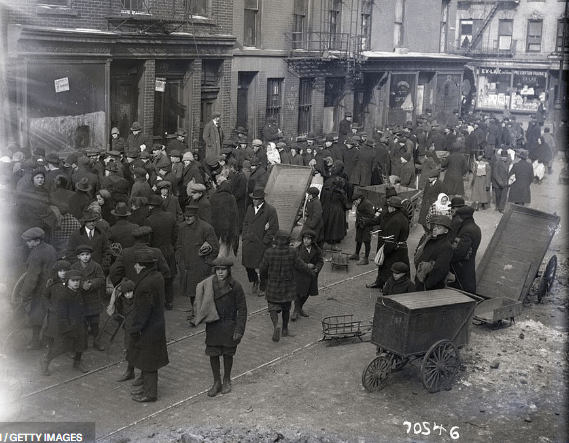
https://www.esquire.com/lifestyle/g20969723/old-new-york-city-vintage-photos/?slide=3 Probably many worried people pictured in that photo from 105 years ago. Yet, everything they were worried about is inconsequential now. How important is the thing I’m concerned about today going to be in 105 years, or 1005 years, or 1,000,000,005 years? I just try to take a wider perspective and just let it go.
Of course sometimes, I can feel too inconsequential, and life can feel pointless. Then I can just take the time to reflect how many things had to happen for this particular consciousness to exist now. How easy would it be to blot myself out of existence by changing one little thing in the past. One heel doesn’t break on my greatn grandfather’s shoe one particular day, and he never meets my greatn grandmother at the shoe repair shop. Suddenly the universe is plunged into a Mike-less reality! It’s not just about the individual. Think of all the factors that allow the Earth to exist and sustain life. The perfect energy of the Big Bang, the Sun able to provide light and heat, the moon to stabilize our gravity. When’s the last time you thanked Jupiter for absorbing all those meteors for us (so ungrateful!)? Anyone witnessing the Big Bang who bet you would be sitting here in this moment reading these words just broke the bank at Las Multiverse Vegas!
Any views on spirituality I have, must conform to my very open-minded view of reality. 2600 years ago, Buddha taught through the dharma about the nature of reality, the existence of “signs” (the everyday things around us that seem real but are not true reality), and “relative truth” and “absolute truth.” Relative truth has nothing to do with “alternative facts” (a.k.a. “lies”). It instead represents the reality we experience daily and come to trust the most, but there is a more real reality in the absolute truth. This all might sound pretty Woo Woo but is actually in line with the modern scientific view of reality and consciousness. I’ll summarize what I learned from David Dunning (of the Dunning-Kruger Effect) on Adam Conover’s podcast Factually!. I’ve only learned a little about this topic, but I’m pretty sure I’ve got it figured out (if you missed the irony there, just click on the Dunning-Kruger Effect link). Basically our brains present us a user interface based on data from our sensory systems. This will make sense to those who remember the days you opened up your computer and saw a black screen with characters that said c:\>
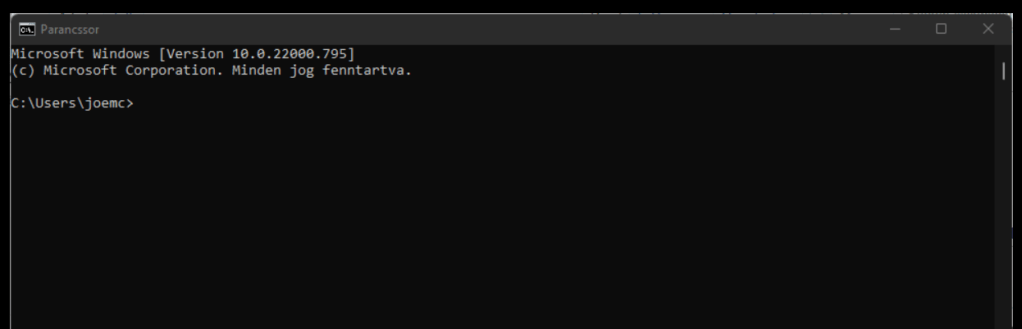
https://en.wikipedia.org/wiki/Cmd.exe#/media/File:Command_Prompt_on_Windows_11.png Instead of something that looks like

https://www.theguardian.com/technology/2014/oct/02/from-windows-1-to-windows-10-29-years-of-windows-evolution The absolute truth is that black screen and string of characters. It still exists and is how you actually get to your program. The relative truth is I clicked on picture to bring me to the place that could tell me the name of the actor who played Jethro on the Beverly Hillbillies (don’t click away, it was Max Baer Jr.!). Dunning explains that our brains present us with a version of reality that it not truly the real world but does give us the best chance of surviving in the world. We think we see the smooth, parabolic path of a ball flying through the air at us, but instead our cognition presents a version of the flight that lets us catch it or get out of the way. Besides these revelations, we all understand we see light in the visible spectrum and not all forms of electromagnetic radiation, hear sounds within a limited range, and smell and taste based on what receptors we have. Our “reality” is just a perception of our mind. Once I understood that and stopped grasping and attaching to relative truth, my spiritual understanding of the world opened wide.
The F-Word
So a natural question is what is the role of faith in a evidence-based spirituality. Thich Nhat Hanh (Thay) says in The Heart of Buddha’s Teaching, “Faith (shraddha) in Buddhism, does not mean accepting a theory that we have not personally verified. The Buddha encouraged us to see for ourselves.” (Chapter 21). I don’t see the need for leaps of faith in spirituality. Instead I try to take ideas I am presented at face value, with non-judgement and non-attachment. Learning of the Four Noble Truths, the idea of not needing to suffer anymore was very compelling. Studying it more, I learned of the nature and causes of suffering. I then reflected on my own experiences and recognized all the ways I was responsible for my own suffering. Even when outside events seemed to cause my suffering, it was in fact more about my reaction to them. I chose a diet of suffering through craving and attachment and dismissed the joy that could be present! That is a solid faith based in exploration and experience. This represents just one example but shows how spirituality in the form of openness to absolute truth doesn’t require “blind faith.” A willingness to be open and seeking to understand is sufficient.
Part of my spiritual path lately has taken the form of poetry writing. Here I will share one written reflecting on the nature of faith after reading Thay’s teaching on it.
Once told my faith should be offered
Unquestioning, unflinching, without the benefit of proof
To learn later that faith is built through action
Faith is concrete, found on the path of dharma
When I quiet my mind, the voice of God and the hand of Buddha can be found.
I wish for you to experience pleasant perceptions of the mind and non-attachment to them (or just have a good day)!
-
Hello World!
Welcome to WordPress! This is your first post. Edit or delete it to take the first step in your blogging journey.
-
Subscribe
Subscribed
Already have a WordPress.com account? Log in now.
 Two Shadows

